

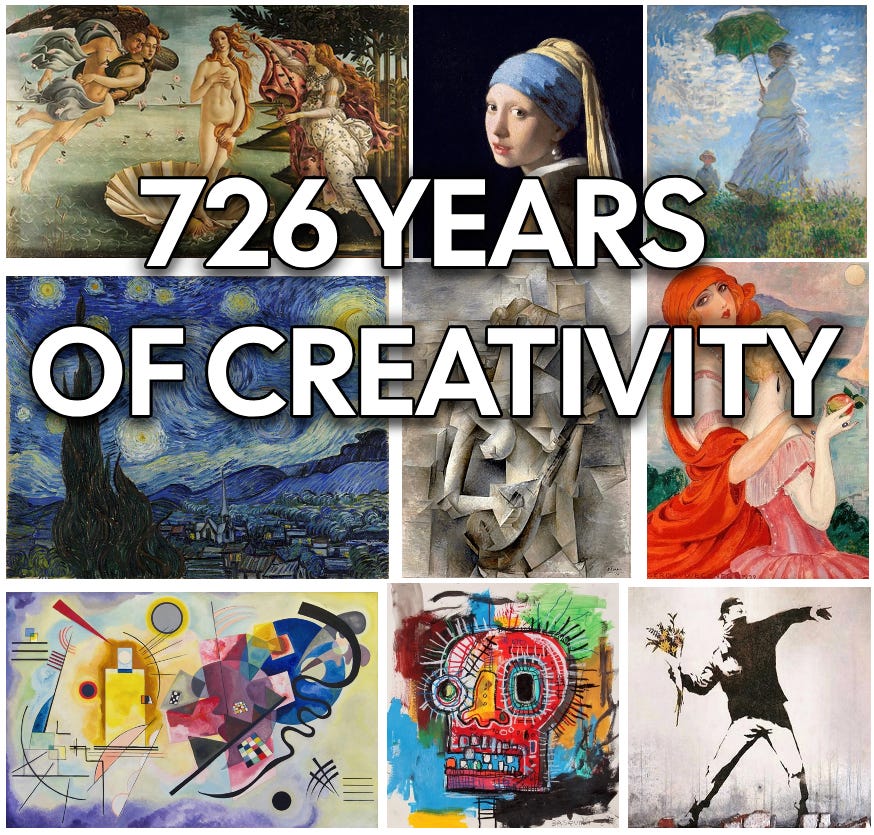
Little did I know that such an innocent question would lead to an obsessive week of research, exploration, and a few too many late nights.1
Humans are wired to create. We all have imaginations, and that’s the point of origin of creativity. Advancements, politics, social structures, and cultures all influence what we imagine, and therefore what drives our creativity. Which makes me think that the times we live in have a great effect on creativity. Before I looked at what that meant for us today, I wanted to check out the history of creativity in the context of the times in which they existed. Which meant mapping out the events and philosophies of the eras alongside the art movements and the literary trends, or music2 alongside the notable creatives of the times and a what their lives were like. I wanted a compressed, yet comprehensive view.3
I broke my timeline into the following centuries:
1300 – 1600 : Late Middle Ages
1600 – 1750 : Early Modern Era
1700 – 1900 : Modern Era (overlaps a smidge with previous)
1900 – 2000 : Modern Era
2000 – now : Contemporary Era (so far)
Right. So let’s go.
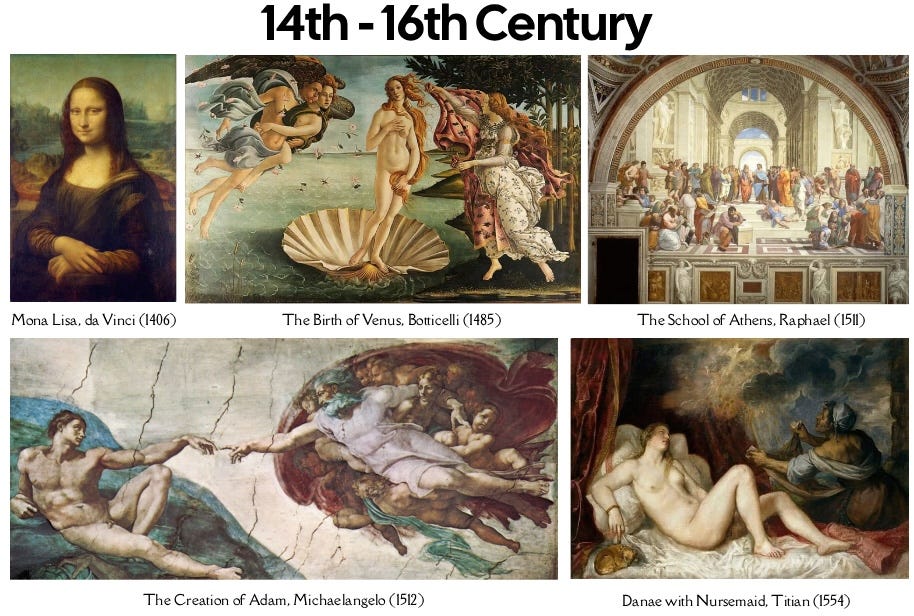
Name of Era: LATE MIDDLE AGES
1300-1600
Major Historical Events:
Printing Press - Newspapers (1450)
Columbus’ first voyage to America (1492)
Scientific Revolution : Copernicus (1473-1543), Galileo (1564-1642)
Humanism (an intellectual movement started in 14th century Italy)
Prevailing Period: Renaissance
Art Movements:
Renaissance
Baroque Movement (end of this period)
Evolution of Storytelling: The rise of Prose Fiction. Some writers from this era remain the most influential of all time creating literary techniques still used today.
Some Notable Creatives:
ARTISTS: Titian (1490 – 1576), Leonardo da Vinci (1452 -1519), Michelangelo (1475 – 1564), Sandro Botticelli (1445 – 1510), Raphael (1483 – 1520)
WRITERS: Dante (The Divine Comedy - 1308) Geoffrey Chaucer (1343–1400, The Canterbury Tales), Shakespeare (1564 - 1616), Miguel de Cervantes (1547-1616, Don Quixote)
COMPOSERS: Josquin des Prez (1450 – 1521, Ava Maria), Claudio Monteverdi (1567-1643, Opera)
Other eras designated to this time:
Age of Discovery (1400 - 1650)
Age of Exploration (starting 15th century)
The Elizabethan Era (1558 - 1603) - known for intrigues, and power struggles.
The Jacobean Age (1603 - 1625) - little deviation in style from Elizabethan Era.
Notes on this time period:
Humanism caused quite a kerfuffle in the status quo. It centered around the belief that God gave people options and potential. To embrace this, we must act. It shifted the focus from blindly following the church to encouraging intellectual vigor.
Many Renaissance artists died young, in their 30’s to 50’s, due to toxic art materials, pandemics (tuberculosis, the plague), and unhealthy lifestyles. Some managed longer lives due to cleaner living, like da Vinci (69) and Michaelangelo (89).
The majority of art was produced in workshops run by a master, with a team of assistants, apprentices, and slaves. Apprentices were taken in their early teens and trained for up to 5 years. Once trained, they became assistants and received a salary. (Ah, such dedication to learning one’s craft! Admirable.)
Art was usually commissioned and paid for in advance by the wealthy. These works had a function to fulfil as dictated by its patrons, to inspire devotion, record history, and depict recognizable figures.
It took on average between 2 – 4 years to complete a work of art. (Ha! Imagine someone today taking 4 years to complete a painting. Mind boggling.)
***
Moving on….
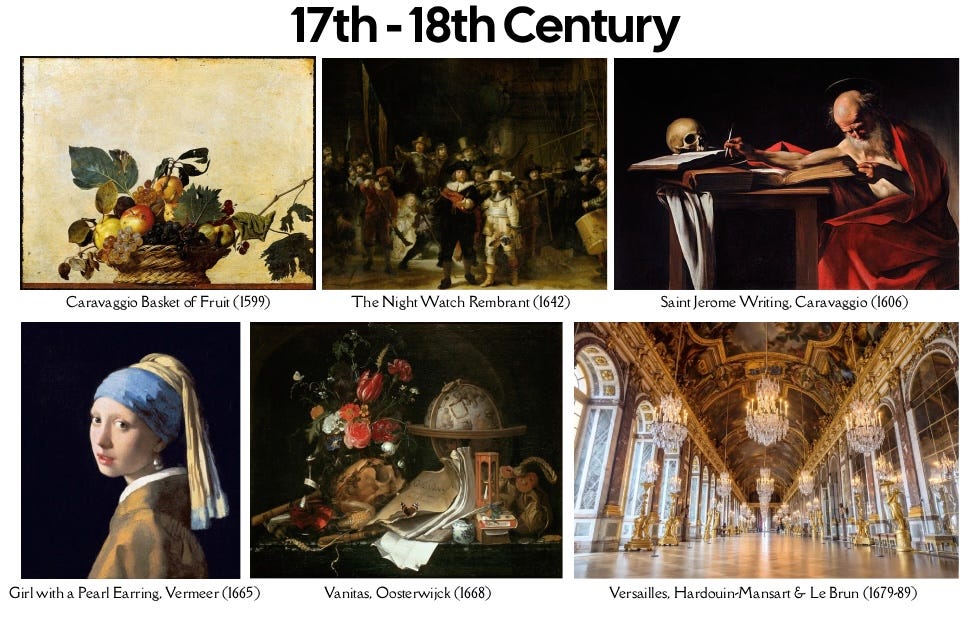
Name of Era: EARLY MODERN ERA
1600 - 1750
Major Historical Events:
Thirty Year War – Europe (1618 - 1648)
The Spanish Inquisition (1633)
Isaac Newton – experiments with gravity (1664)
Great Plague in London kills 75,000 (1665)
Spanish Succession (1700 – 1714)
Austrian Succession (1740 to 1748)
Prevailing Period: The Enlightenment
Art Movements:
Baroque Period continued
The Romantic Style (started at the end of this period)
Rococo (1700 - 1775)
Vanitas (16th – 17th Century) – Symbolizes transient life and vanity of ambition and desires
Evolution of Storytelling: Many Enlightenment writers were scientists, philosophers, and physicians. Writings encouraged the separation of church and state. Satire was developed to critique the conservative, religious establishments in an amusing way.
Notable Creatives:
ARTISTS: Rembrandt (1606 – 1669), Caravaggio (1571–1610), Johannes Vermeer (1632 – 1675), Maria van Oosterwijck (1630 – 1693)
WRITERS: Miguel de Cervantes (1547-1616 - Don Quixote), Isacc Newton (Principia 1687 - the foundation of physics), Voltaire (Candide - 1759), Jonathan Swift (Gulliver’s Travels - 1726), Benjamin Franklin (1706–1790)
COMPOSERS: Bach (1685 – 1750), Mozart (1756-1791), Beethoven (1770-1827)
Notes on this time period: A focus on science, intellect and rational thought. Liberty and the freedom of individual expression were the key ideas of this time which contributed to the element of excess in this era. The Enlightenment seems to have ended as its philosophies neglected to offer people solace. The Reign of Terror (1793 – 1794) following the French Revolution cast doubt that an egalitarian society could govern itself. This era did, however, provoke the exploration of emotion in the following cultural movement of Romanticism. The optimistic belief in human progress from this era has continued and is a strong motivator of modern day society. (Side note: Progress in our accomplishments flourish, while we still seem to struggle with some aspects of rational thought and individual expression.)
***
Now we start to get more modern…
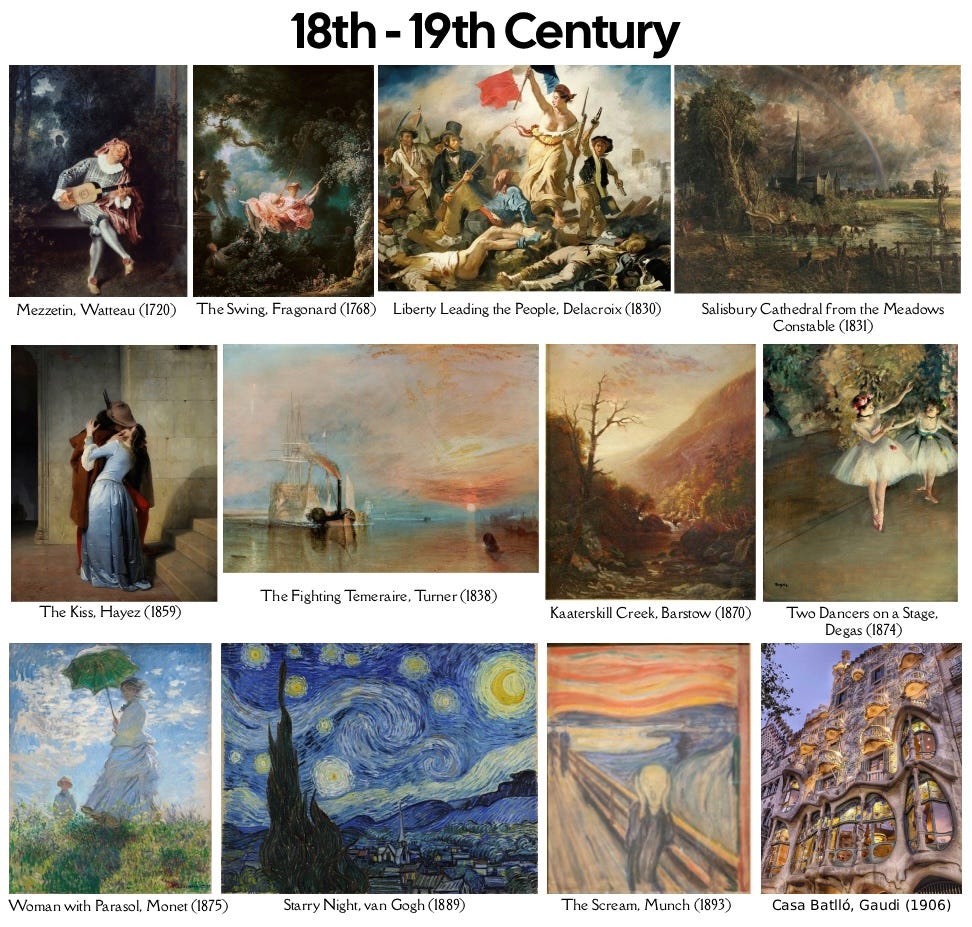
Name of Era: MODERN ERA
1700 - 1900
Major Historical Events:
Agricultural Revolution - population boom (1700s-1800s)
Steam Power (Developed through 1712 - 1764)
Seven Years’ War (1756–1763)
Invention of the Spinning Jenny (1765) Revolutionized textile manufacturing
The Slavery Abolition Act passed in the British Empire (1833)
American Civil War (1861–1865)
The 13th Amendment to the U.S. Constitution abolishing slavery (1865)
Henry Ford introduced the moving assembly line (1913)
Factories and Mass Production (late 19th Century)
Later part of the 19th century - cars, telephones, lightbulbs, and airplanes
Prevailing Period: Industrial Revolution
Art Movements:
Neoclassicism (1760 - 1830)
Romanticism continues (late 1600’s - 1850)
Realism (1840 - 1880) (depicted middle/lower class)
Academic Art (1850 - 1900) (fine arts)
Aestheticism (1860 - 1900) (art for art sake)
Impressionism (1860 - 1890)
Post Impressionism (1880 - 1905)
Neo-Impressionism (1886 - 1906) (dots)
Art Nouveau (1890 - 1910)
Symbolism (1880 - 1910)
Evolution of Storytelling: Romanticism, poetry, the start of Gothic fiction and Detective stories. (Woohoo!)
Notable Creatives:
ARTISTS: Antoine Watteau (1684-1721), J. M. W. Turner (1775 – 1851), John Constable (1776-1837), Eugène Delacroix (1798 – 1863), Claude Monet (1840 – 1926), Edgar Degas (1834 – 1917), Pierre-Auguste Renoir (1841 – 1919), Vincent Van Gogh (1853 – 1890), Paul Cézanne (1839 – 1906), Gaudi (1852 – 1926), Edvard Munch (1863 – 1944), Francesco Hayez (1791–1882)
WRITERS: William Blake (1757 - 1827), Lord Byron (1788 - 1824), John Keats (1795 - 1821), Mary Shelley (Frankenstein 1818) Walter Scott (The hunchback of Notre Dame - 1831) The Brontë Sisters: Charlotte (1816-1855), Emily (1818-1848) and Anne (1820-1849), Brothers Grimm: Jacob (1785–1863) and Wilhelm (1786–1859), Edgar Allan Poe (1809 - 1849), Sir Arthur Conan Doyle (1859 - 1930), H. G. Wells (1866–1946), Oscar Wilde (1854 – 1900)
COMPOSERS: Bach (1685 – 1750), Mozart (1756-1791), Beethoven (1770-1827)
Other eras designated to this time:
Georgian Period (1714 - 1830)
Victoria Age (1837 - 1901)
Age of Imperialism (1800 - 1914) - Colonization of other countries.
Second Industrial Revolution (1869 - 1914) or the Technological Revolution
Notes on this time period:
A period of rapid population growth due to the Agricultural Revolution resulted in industrialization and technological advancement. It led to significant changes in manufacturing, transportation, and urbanization, shifting economies from rural mindsets to industrial. This was also a time of social concern over the benefits of advancement versus the cost to humanity. (Sound familiar??)
A new social working class emerged from factory labour, which was marked by low living conditions, lacking basic sanitation and running water. “Realism” highlighted the reality of human conditions, emphasizing detailed depictions of everyday life.
New technology provided new opportunities for artists, such as new techniques, materials, and methods. In 1843, John Goffe Rand invented the tin paint tube which enabled artists to leave the traditional studio setting and enjoy plein-aire painting.
Opera and a transformation in concert culture brought music to the public. The Royal Albert Hall opened in 1871.
This was kind of crazy time for creativity. Freedom of expression coupled with difficult times and rapid growth saw an explosion of different movements.
***
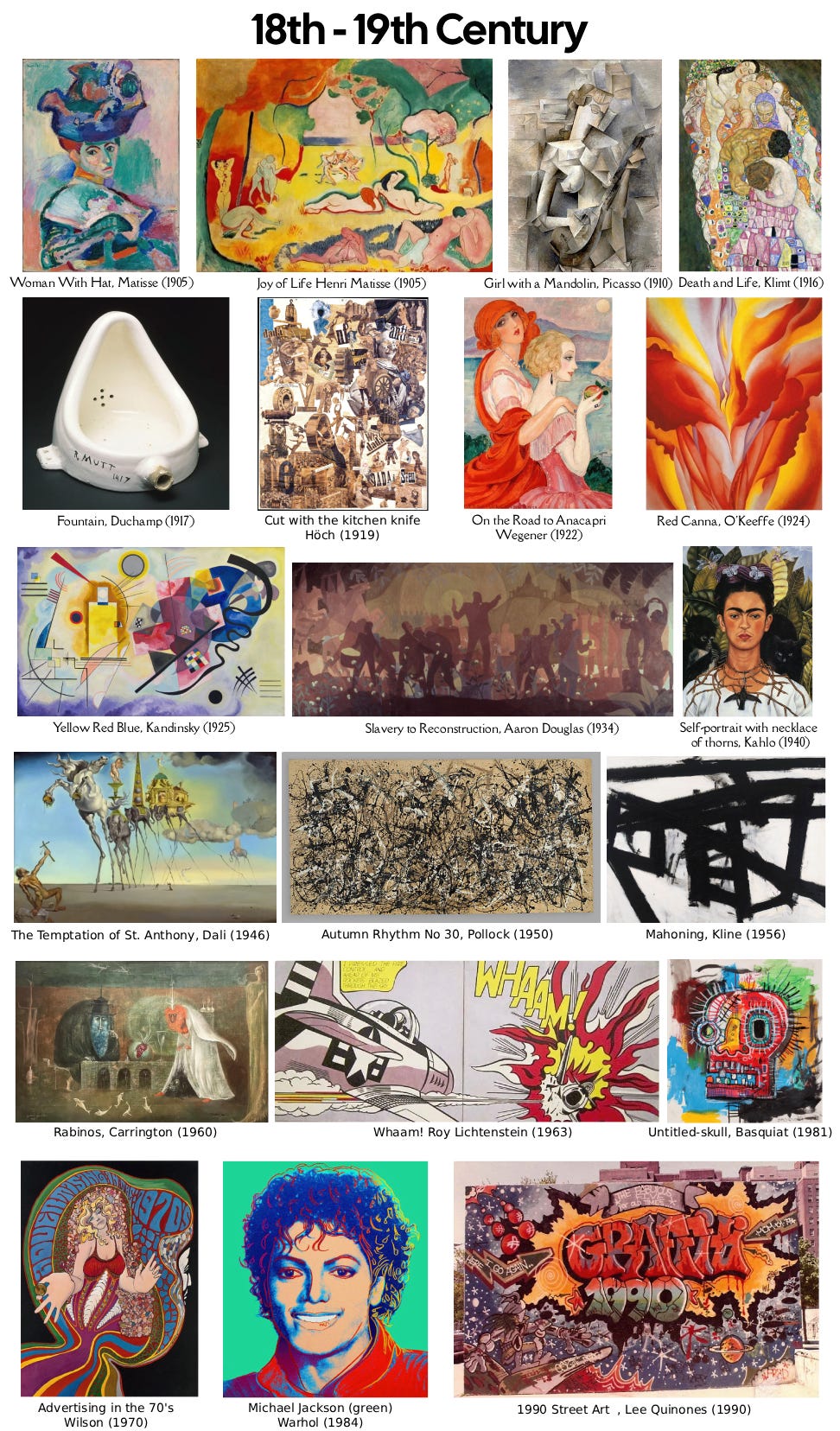
Getting a little closer to present… I went a little crazy with the images, but they all seemed relevant to “paint a picture” of this wild and wacky era.
Name of Era: MODERN ERA (still)
1900 – 2000
Major Historical Events:
WW1 (1914 - 1918)
The Great Depression (1929 - 1939)
WW2 (1939 - 1945)
Emergence of the World Wide Web (1993)
Emergence of Psychoanalysis (1890)
Prevailing Period:
Postmodernism
Contemporary Period (1945 - present)
Art Movements:
Futurism (1909 - 1944)
Fauvism (1905 - 1910)
Expressionism (1905 - 1930)
Cubism (1907 - 1920)
Harlem Renaissance (1910 - 1930)
Dadaism (1915 - 1924)
Surrealism (1920 - 1966)
Percisionism (1920 - 1930)
Art Deco (1920 - 1940)
Abstract Expressionism (1940 - 1965 +)
Pop Art (1950 - 1970)
Photorealism (late 1960’s - present)
Psychedelic Design (1960’s)
Minimalism (1960 - 1970)
Neo-Expressionism (1970 – 1980 +)
Contemporary (1970 - Present)
Evolution of Storytelling: Poetry, the Lost Generation (struggling to find meaning in a world devastated by war) Sparse language and exploring inner thoughts. The “Unreliable narrator”, stream of consciousness and psychoanalytic theories, experimentation with genre and form. Modern-format comic book was born in 1930’s.
Notable Creatives:
ARTISTS: Gustav Klimt (1862 – 1918), Marinetti (1876-1944), Henri Matisse (1869-1954), Edvard Munch (1863–1944), Wassily Kandinsky (1866-1944), Picasso (1881–1973), Gerda Wegener (1885 – 1940), Josef Albers (1888 – 1976), Aaron Douglas (1899–1979), Marcel Duchamp (1887–1968), Salvador Dali (1904–1989), Georgia O’Keeffe (1887–1986), Jackson Pollock (1912–1956), Leonora Carrington (1917–2011), Roy Lichtenstein (1923 – 1997), Andy Warhol (1928–1987), Frida Kahlo (1907 - 1954), Franz Kline (1910 – 1962), Wes Wilson (1937 - ), David Hockney (1937 - ), Jean-Michel Basquiat (1960 – 1988), Lee Quinones (1960 - )
WRITERS: Frank Baum (1856–1919), Franz Kafka (1883-1924), Ernest Hemingway (1899–1961), J. R. R. Tolkien (1892–1973), F. Scott Fitzgerald (1896–1940), Virginia Wolff (1882 - 1941), J. D. Salinger (1919–2010), Gabriel García Márquez (1927–2014), Philip K. Dick (1928–1982), Ray Bradbury (1920–2012), Harper Lee (1926–2016), Ursula K. LeGuin (1929–2018), Margaret Atwood (1939 - ), Douglas Adams (1952–2001)
MUSICIANS: Louis Armstrong (1901–1971), Ella Fitzgerald (1917–1996) The Beatles, Prince, Queen, Michael Jackson, Ray Charles, David Bowie, Aretha, Elton John.
Other eras designated to this time:
Edwardian Period (1901 - 1910)
Atomic Age (1945 - Present)
Cold War (1947 - 1991)
Post-Cold War Era (1991 - early 2000’s)
Age of Information (1975 - Present)
Notes on this time period:
Catastrophic global conflicts that had a devastating and profound impact on politics and culture. The nuclear arms race began. (1949)
In the later part of the century, the rise of digital technology and social platforms transformed the way society functioned, and it’s commerce and entertainment. More global connections, less local interactions. The emergence of the web started in this era, although it’s effects became more evident and widespread in the 21st century.
Writers of this era changed the way many people perceived truth and reality.
The 60’s bare special mention as it was such a dramatic time of change. Known as the “Countercultural Decade” or “The Radical 60’s” this time period saw technical achievements in space exploration and technology, but the social and political movements of the 60’s were the biggest factor in the creativity of the times. The anti-war movement and the civil rights movement, along with the rise of feminism and gay rights made this decade rich for social revolution and reform. Hippies advocated social liberation, including the sexual revolution, questioning government, and demanding freedom and rights for all. The widespread use of drugs and psychedelia had to have had a dramatic effect on creativity.
Honestly, there’s so much to be said about the creativity of this era, it’s hard to be succinct. Boundaries were pushed, and creatives reveled in being uncomfortable and prolific. Their efforts reached more people than ever before, and international mega stars were born. Creatives changed the world in this era.
***
And now… we’ve reached our time. They say that you can’t know a period until it’s considered in hindsight. But here’s a peek of where we are so far…
Name of Era: CONTEMPORARY ERA
2000’s
Major Historical Events:
First legal Same-Sex Marriage performed in Canada in 2001 (initially denied, it became legal in 2003, and was retroactively approved.)
Ipod (2001) - changed the way people listened to music.
Terrorist attacks 9/11/2001 sparking wars in Afghanistan and Iraq.
Climate Change, and devastating natural disasters.
Facebook (2004) - starts social media boom
Global Financial Crisis (2007 - 2008) causing “The Great Recession”.
Netflix (2007) - changed the entertainment industry.
The Black Lives Matter movement, founded in 2013.
Covid (2019–2023)
Identity Rights and racial Justice
Lots of Space Exploration
Digital Platforms/Social Media
The Rise of ADHD
AI
Prevailing Period: The Information Age
Art Movements:
Digital Art
Digital Photography
Post-Internet Art
Bio Art
NFT Art (Crypto) (2021 - 2023)
Figurative Painting (2015 - Present)
Fiber Art
Systemic Art (geometric patterns)
Pop Art (commercial imagery)
Street Art & Urban Art
VR Art Experiences
AI content generation
Evolution of Storytelling: E-books, Kindles, audiobooks, and self-Publishing changed the publishing world. Genre fiction flourished, and different forms of storytelling evolved from new voices not heard from before. Graphic novels found broad popularity in 1970’s. The non-linear narrative flourished, and “voice” became a strong draw within literature. YA novels exploded. Storytelling opened up for diverse protagonists and lines blurred for villains and anti-heroes.
Notable Creatives:
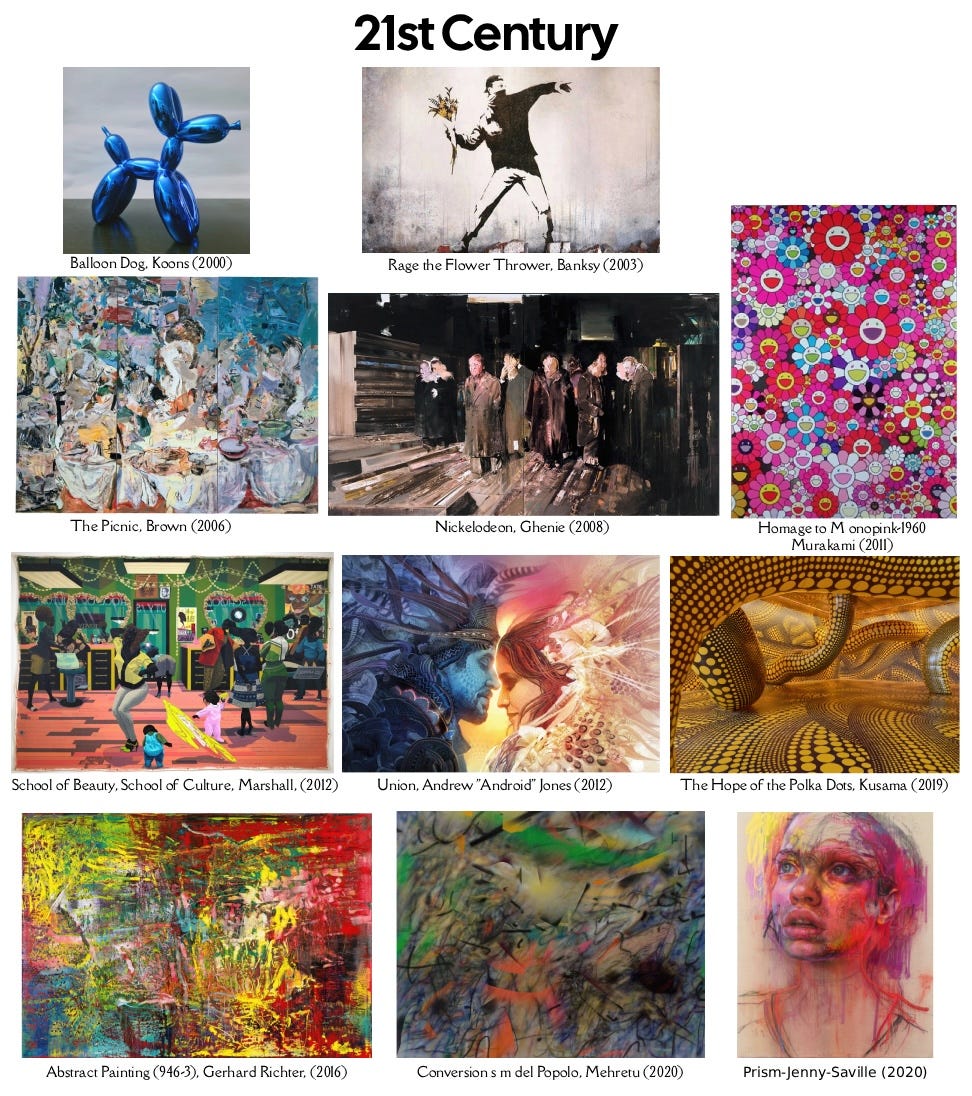
ARTISTS: Banksy, Andrew “Android” Jones, Jean-Michael Basquiat (1960–1988), David Hockney (1937 - 2026), Yayoi Kusama (1929 - ), Jeff Koons (1955 - ), Gerhard Richter (1932 - ), Kerry James Marshall (1955 - ), Takashi Murakami (1962 - ), Cecily Brown( 1969 - ), Julie Mehretu (1970 - ), Jenny Saville (1970 - ), Adrian Ghenie (1977 - ),
WRITERS: Cormac McCarthy (1933–2023), Margaret Atwood (1939 - ), Stephen King (1947 - ), Dan Brown (1964 - ), Emily St. John Mandel (1979 - )
MUSICIANS: Eminem, Foo Fighters, Coldplay, Beyoncé, Avril Lavigne, Britney Spears, Usher, Red Hot Chili Peppers, Rihanna, U2, Lady Gaga… so many more.
Notes on this time period:
There are a lot of similarities to the Industrial Revelation, where technological advancements bring new opportunities for creative works, while also carrying concerns for the human cost of the advancements. Each era has had their own technical advancements, but today, these advancements have made it into everyone’s home, and effect everyone’s life.
Because of the internet, knowledge on anything is readily available, almost instantly. An abundance of entertainment is readily available in many different ways, much of it free. Social media has made sharing creative endeavours instantaneous and without limits. It has also provided a means for social approval from strangers en mass. It’s an age of instant gratification. Patience seems to be in short supply.
There is a rise in ADHD, and recognition of different thought processes.
Idle time or daydreaming has become undesirable for most people. On average people wait no more than 10 seconds of doing nothing before they’re on their phone for external stimulus (doom scrolling).
I talked to a friend about all this. She’s a parent and an educated artist. She said that parents today really want their kids to have an easier life. So while having good intentions, they’re not teaching their kids to ever be uncomfortable. And being uncomfortable is really important for developing creativity. For enduring a learning curve, and pushing ideas beyond comfortable boundaries.
There are more ways to be creative than ever before. However, creativity as a whole is on the decline. Creativity is a relatively new topic of philosophy, only explored more thoroughly over the past two decades.
AI. Yeah, I don’t wanna talk about it.
MY TOP TAKEAWAYS FROM ALL THIS…
This is the standard definition of Creativity: Generating new and valuable ideas or works through the use of imagination. (“valuable” in that it is not simply original nonsense.)
It seems obvious to me now that when we talk about motivation for creativity, there are a few different considerations.
What’s happening in the world greatly influences what is being created.
Wars, advancements, economics, politics, and cultures drive what and how we create.
Expectations have shifted.
We’ve gone from training for up to 5 years and expecting a work of art to take 2-4 years, to being able to single-handedly create a work in minutes with no training. Creativity is anyone’s game now, and expectations may not correlate to effort.
External motivations have changed dramatically.
External rewards have always included financial gain, accolades, and praise, whether it’s to record history, or enjoy freedom of expression. But today the reward platform has exploded with the internet and social media. Exposure is readily available, and often free. Global recognition is mighty appealing and more common than ever.
Internal motivations... this is where it gets kinda of interesting.
Aristotle’s idea of virtue is that your actions must be done “for its own sake” because the doing is the value, as opposed to praise, money, status, fame, or manipulation. This was debated, of course. Some said the muse motivated creativity. It was in the 18th century that the idea of “Free play of the imagination” drove creativity. It’s interesting to note that once “play” became a common theory, creative works started to wildly deviate. Today we’re much more open with our internal motivations. We create to feel fulfilled, find beauty, explore, challenge, and share ideas, feel inspired, and help figure out ourselves and the world.
Recent studies4 show that people become less productive in a competitive environment, suggesting that intrinsic motivation might be hampered by extrinsic motivation. However, if people first focus on the value of creativity in itself, taking pleasure in the activity, then external rewards can actually enhance their creativity. So it comes down to the initial driving force to create.
And here’s the thing. I don’t think this has changed. We’ve always been built for creativity as part of being human. We are born with an imagination and a subconscious, and the ability to solve problems and make new connections, regardless of the rewards. It’s who we are. We’re in a time when that’s being threatened by various forces instead of encouraged. But as is the way with the unrelenting human spirit, we’re difficult to silence. Be bold, be brave, and be relentless.
If you feel safe in the area you’re working in, you’re not working in the right area. Always go a little further into the water than you feel you’re capable of being in. Go a little bit out of your depth. And when you don’t feel that your feet are quite touching the bottom, you’re just about in the right place to do something exciting. - David Bowie
I’d love to hear your thoughts. Are you concerned for our collective creativity? Are you optimistic, and even excited by the opportunities of today? Why do you create?
If you’d like links to my research for this post, message me and I’ll send them along. :)
I’ve left a lot out, but I think we can agree that’s for the best. That said, if you notice anything factually incorrect, please do let me know.
Being a writer and artists, I did lean more heavily on these in my research.
I’ve never studied Art History, although I always wanted to, so this turned into a kind of sideways wish fulfillment.
Teresa Amabile, Matthew Kieran
What an amazing overview! So cool to take a bird's eye view of how historical events overlap and impact creative movements. I love how you explored artists responding to their world, and you got me thinking about how artists influence history, too.
For example, for centuries women were not allowed to apprentice or display their work, yet Renaissance and Early modern artists like Artemisia Gentileschi and Lavinia Fontana (and others) found ways to practice and earn commissions despite sometimes violent pushback and attempts to erase their accomplishments. Yet they inspired their peers as well as later generations to (eventually) broaden the concept of who has the right to create art. (Everybody!)
A better future has to be imagined before it can be implemented, and who imagines better than artists? Kind of beautiful to think about how the human urge to create can become so much more.
I love all the research that went into this--and that Bowie quote is fantastic! Putting that on a Post-It for future reference now...